by Kevin McCue
The mid-crustal magnitude 4.5 earthquake occurred at 7:08pm local time. More than 7400 people reported to GA that they felt the earthquake, from southern NSW and throughout Canberra. During the incident, chandeliers shook at the National Press Club in Barton while University of Canberra vice-chancellor Bill Shorten was delivering a lecture. The editor, Kevin McCue in Aranda, quietly watching the news on the ABC, didn’t feel it, his home didn’t shake, but his sister messaged saying their building in Campbell shook – a call to work.
Reports to GA came from across Central New South Wales, Grenfell, Cowra, Young, Forbes and Parkes, Sydney, Wollongong and Canberra. Seismologist Al Sheehan in Oberon reported: I was sitting at my computer processing ultrasonic bat calls at the time. I heard and felt a deep rumble. At first I thought it was a vibrating road roller (our neighbour has just recently resurfaced all their roads and pathways ready for an open garden day), but I very quickly realised what it was because the intensity grew and receded. It only lasted a couple of seconds. I didn’t notice anything audibly rattling, but the vibration was definitely felt as well as heard.
I immediately checked DataView on my Raspberry Shake (R21C0) and there was a beautiful signal, not REAL close by the P-S interval so I was excited it was of a significant size to be felt like that. So I stopped processing bat calls, and fired up the seismology software and started responding to locals who all wanted to know if “my gadget” felt it. Of course I had to wait an hour to access any Raspberry Shake data though their FDSN server, but downloaded some data from other station in the meantime in preparation to having a crack at locating it in Waves.
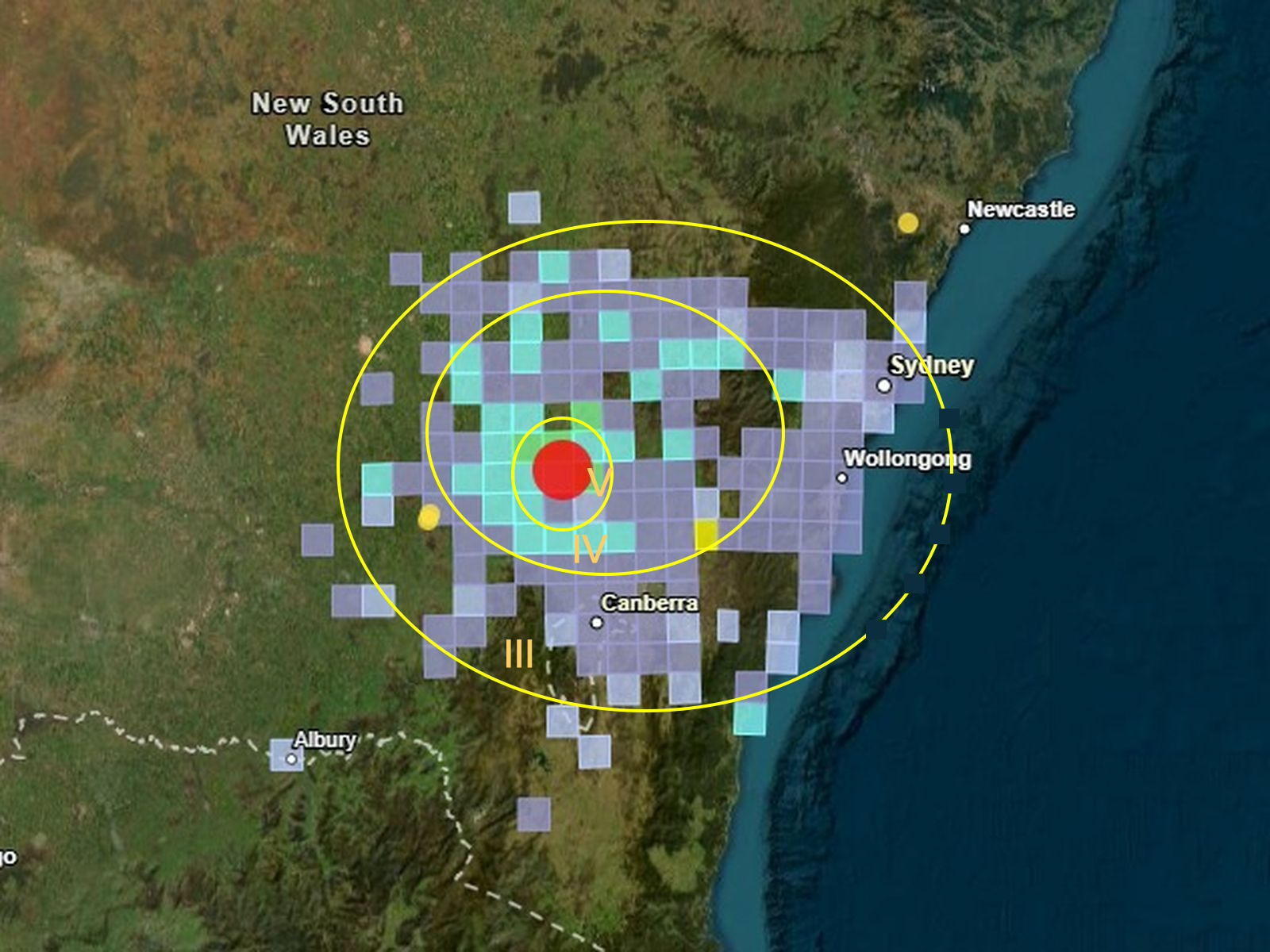
Figure Felt reports mapped by GA with Editor’s interpreted isoseismal lines (yellow) superimposed.
‘Freight train’ earthquake triggers precautionary checks at regional NSW dams
by Melinda Hayter
Water NSW carried out precautionary checks of Wyangala and Burrinjuck dams to check for any unusual seepage. (ABC News: Jake Sturmer)
Richard Apps, who lives in Young, told the ABC Riverina breakfast program he initially thought the earthquake was a large truck driving by his home. “I hear this massive, really deep rumbling noise and thought ‘gee, he must be going a bit quick’, and I stuck my head out to see if I could see him drive past, and the next minute the whole family flies out of the house,” he said. “The whole barbecue area was shaking and it was like someone was just wobbling the roof, like a bomb had gone off.”
Water NSW spokesman Tony Webber said Burrinjuck Dam west of Yass, Wyangala Dam east of Cowra and Carcoar Dam were in the vicinity of where the quake struck. He said the storages were built to withstand seismic activity, and last night’s earthquake was “well below” the threshold for concern.
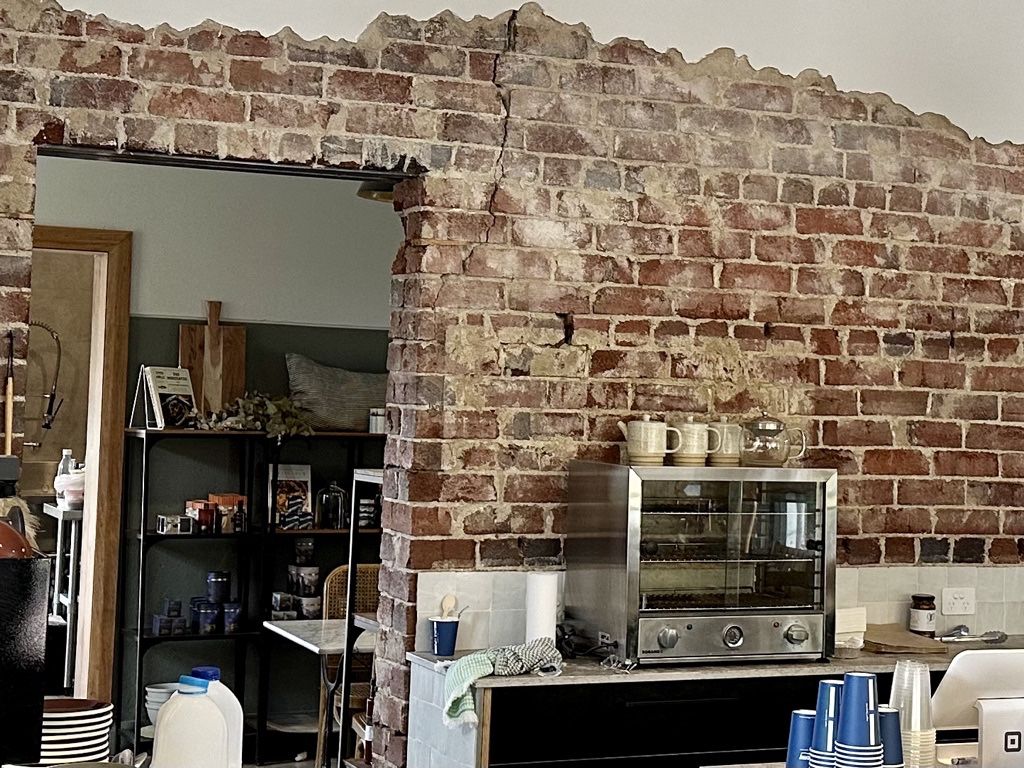
Photo An example of a masonry wall with new plaster conveniently removed in a Boorowa cafe.
But Mr Webber said crews would inspect the Wyangala and Burrinjuck dams today as a
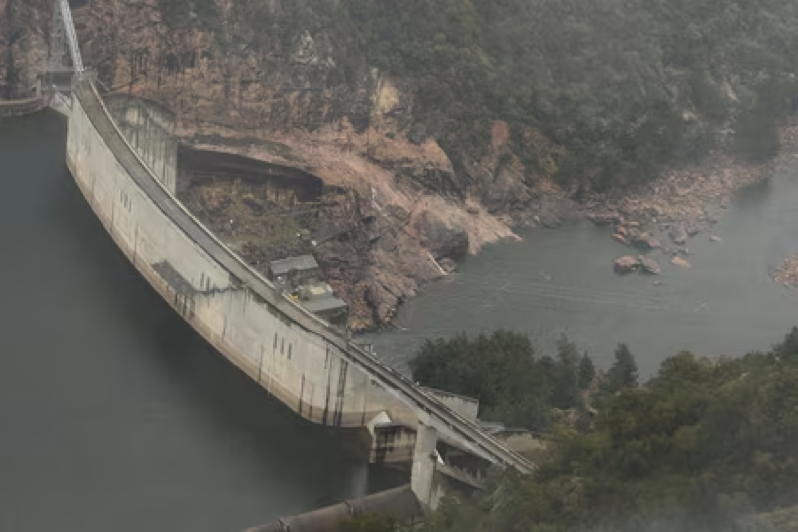
Photo Burrinjuck Dam
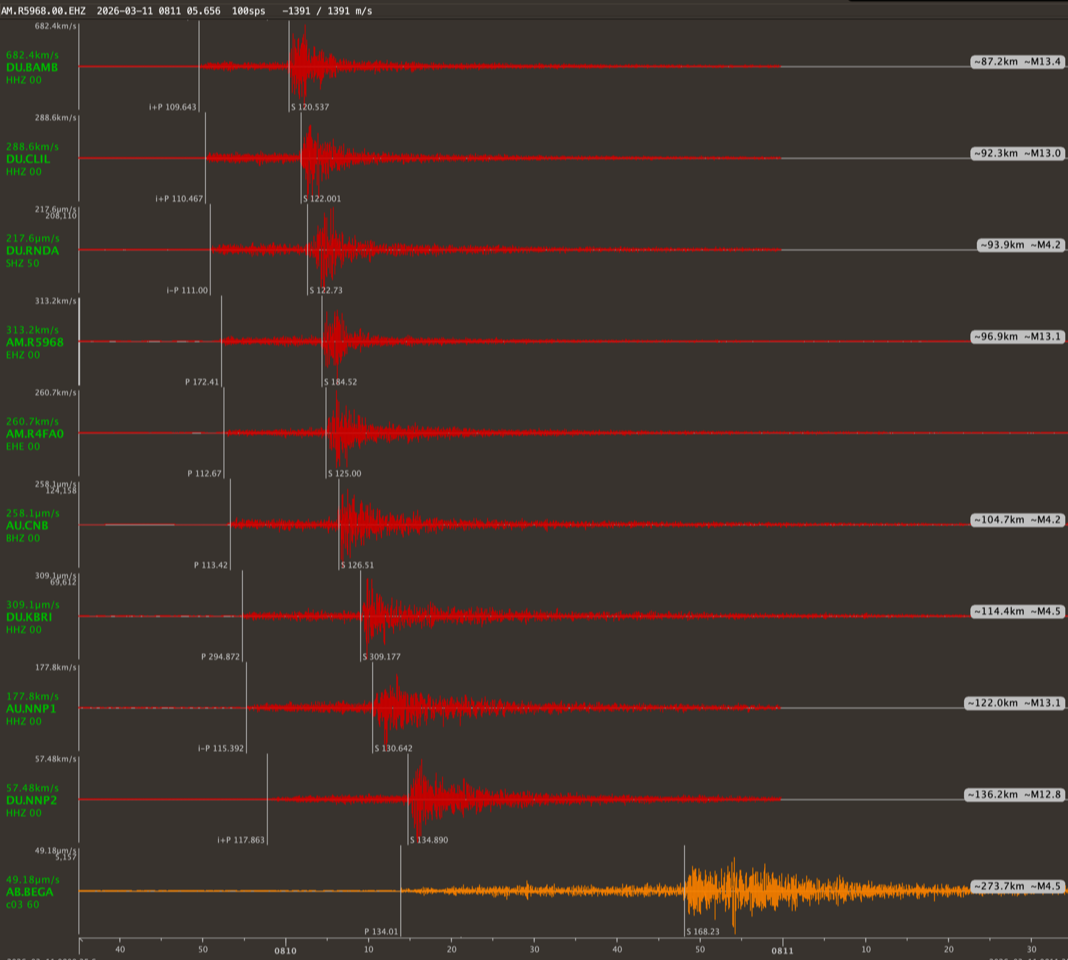
Figure Seismograms recorded on SAA network stations in and around the ACT.
precaution.”As far as dam operations go, this is probably the biggest [earthquake] in the Central West, but we’ve had some comparable ones in the Hunter in the last few years,” he said. “At this stage, you’d be looking for any increase in the seepage. All dams seep a little water and are designed to do so, but we certainly haven’t seen it in this circumstance. “We’ve also invested in some very sensitive equipment within the dam walls themselves that [doesn’t] detect movement, but detects changes in pressure in the wall.” Mr Webber said the inspections were routine following an earthquake, and site visits overnight had not raised any concerns.
Rye Park resident Roger Kershaw told the ABC Central West breakfast program he had experienced earthquakes before, but none as significant as the one last night. “I was sitting on the back verandah minding my business, having a cold drink, and talking to a mate at Wee Jasper and within 10 seconds he said, ‘I can feel it too’ and he timed it, and it went for 35 seconds,” he said. “It had the photos on the wall of the back verandah really rattling, but nothing fell down or got dislodged that I’m aware of.”
Fellow ABC Central West listener Margaret Charles, who lives on a property just to the north of Goulburn, said she heard the earthquake before she felt it. “It was like a freight train coming through the house. You could hear it coming, then it hit us, and you could hear it going away again. Now our front door won’t open because it’s just moved slightly, so we’ve got to fix that.”
There have been no reports of injuries or damage as a result of the quake.
The Canberra Times reported that it was the biggest earthquake in the region in almost 50 years. Did the earth move for you?
The Canberra Times‘ Megan Doherty March 15, 2026 wrote:
I’m glad I wasn’t the only person not to feel the recent earthquake near Canberra. Retired seismologist and geologist, Dr Marion Leiba, an expert on earthquakes in Canberra, also felt nothing as she walked her greyhound in Kambah. Her daughter, Nadine, at home, also in Kambah, did feel it and quickly rang her mum.
“I was sitting on the couch with my cat watching the news and it felt like someone had suddenly pushed the couch forward,” Nadine said.
After getting the call from Nadine, Dr Leiba, now 80, hurried home to check her own seismograph. Sure enough, there was a huge spike. “I checked the seismograph and went,’Wow’,” Dr Leiba said.
Plenty of other people did feel the rock and roll of the magnitude 4.4 earthquake, which happened near Boorowa, north-west of Canberra at 7.09pm on Wednesday, March 11.
Comment Editor. “Dams are designed to withstand seismic activity well in excess of that experienced last [Wednesday],” a Water NSW spokesperson said. (Parkes Champion-Post https://www.parkeschampionpost.com.au/news/parkes-feels-impact-of-boorowa-earthquake-ijlmb00h)
We don’t doubt the sincerity of the Water NSW spokesperson but:
1. Wyangala Dam construction commenced in 1928 and was completed in 1935. Wyangala Dam is the second oldest dam built for irrigation in New South Wales.The Dam is located approximately 50 km from the epicentre of the recent earthquake NE of Boorowa. The current earth and rock wall was constructed between 1961 and 1971 due to fears that the original dam wall was beginning to lift away from its base, and as a result, would not be able to withstand a major flood (Ed. let alone a strong earthquake). A A$43 million upgrade of facilities commenced in 2009 and was completed in 2016 to raise and lock the spillway radial gates; raise the spillway chute wall; and raise the parapet wall crest. No mention of strengthening to withstand earthquakes. It would be interesting hear from Water NSW just how Wyangala Dam was built to withstand earthquakes, such design well ahead of the introduction of the first earthquake code in Australia in 1979, Standards Australia’s (AS1170.4-1979).
They might also comment on whether the response of the dam wall to such shaking should actually be measured.
2. Engineers don’t design for seepage, they cope with seepage through, around or under a dam and attempt to minimise it. They also diligently monitor the leakage which is strange as they seem to be so reluctant to monitor dam response in an earthquake. Even in Australia all dams get shaken sometime during their lifetime.
It was the biggest earthquake to hit the Canberra region in almost 50 years. Geoscience Australia seismologist Hugh Glanville said the last earthquake of a higher magnitude in the region was a 4.8 magnitude quake in 1977.
“That did cause some damage to the local area, but that’s a reasonably larger earthquake than the magnitude 4.4 that we had on Wednesday night,” Mr Glanville said.
Mr Glanville said the latest earthquake was felt as far south as Albury and Jindabyne and as far north as Dubbo and Newcastle. It was “reasonably large” but not “unusually large” for the local area.
“We have had quite a few earthquakes around this size over the past 100 years in the region,” he said.
Mr Glanville said an average of 17 earthquakes a year had been recorded within 100km of the one that struck on Wednesday night. That’s 348 earthquakes in the last 20 years.
No earthquakes above magnitude 4 have been recorded in the ACT itself. The largest in the Geoscience records for Canberra was a magnitude 3.
“Canberra does however have a similar seismic hazard as the surrounding areas of NSW, so earthquakes, and earthquake damage, have a similar likelihood of occurrence in Canberra as the surrounding region.”
Dr Leiba, meanwhile, wrote the document Earthquakes in the Canberra Region for Geoscience Australia in 2007. She keeps her seismograph at home to keep her hand in the profession (Ed. with help and encouragement from SAA’s David Love). Once a geologist, always a geologist,” she said.
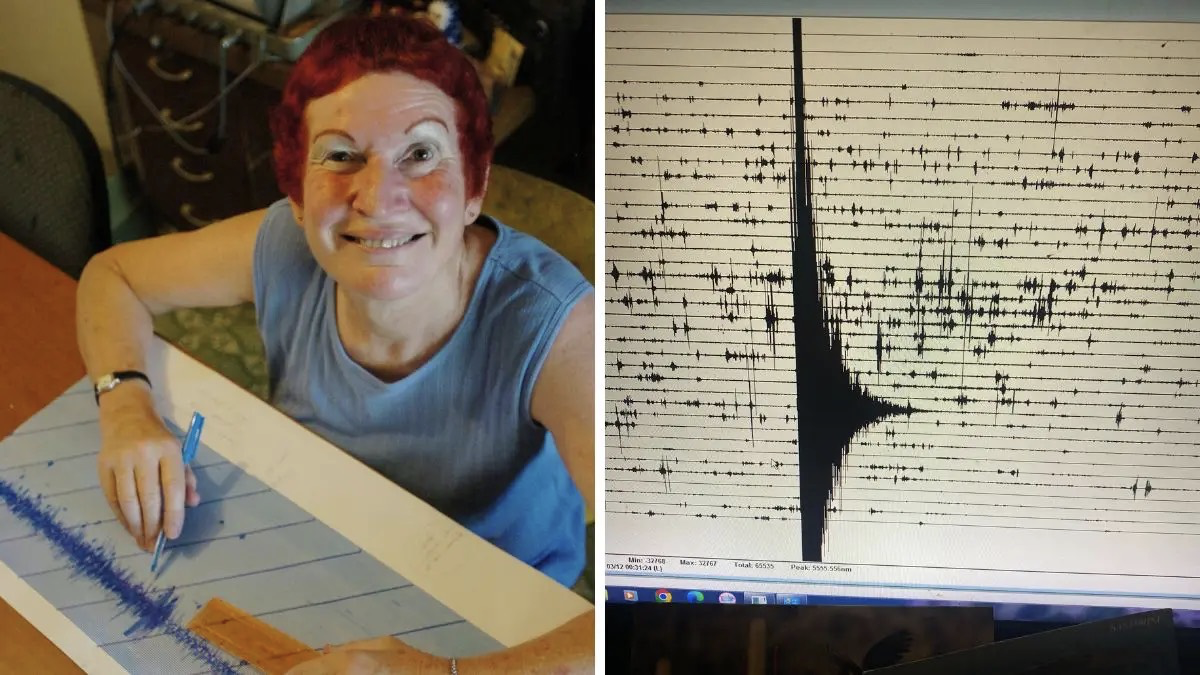
Photos Dr Marion Leiba at work in 2001 and, right, the reading from her seismograph of the recent earthquake. Pictures by Melissa Stiles, supplied.
Ed. In 1977 Boorowa NSW was hit by two earthquakes of magnitude 4.5 and 5.0 on 30 June at 10:48pm and 5 July at 6:05am. The 2nd and larger event was felt over a similar area to that of the 2026 earthquake.
The ANU Research School of Earth Sciences organised a rapid deployment kit (RDK) of nodal seismometers from the ANSIR pool of instruments the following day. Robert Pickle, Sima Mousavi, Juan-Santiago Velasquez, Jack Dent and Meghan Miller spent a beautiful day Thursday 12 March installing 22 nodes to capture aftershocks from the earthquake.
Stay tuned for updates on the data and analyses that will be shared on https://auspass.edu.au in about a month.
AuScope hashtag #NCRISimpact